

How Stress Wrecks Your Health: Cortisol and Adrenal Dysfunction 101
Important news for all my burnt out high achieving ladies! Chronic stress and overwhelm will drive your health into the ground. Sorry - there’s no nice way to say that ❤️
But I’ve battled stress & anxiety my whole life- ever since childhood- so I empathize with whatever you’re going through in this department.
You might see stress as just something ‘mental’ and with little relation to your physical health.
I used to think that too! Even when presented with all kinds of evidence about how stress increases your risk for heart disease and other serious health problems, I still refused to believe that it applied to me.
I can also understand how easy it is to see stress as an indicator there’s something inherently ‘wrong’ with you- I mean, in a way isn’t that what anxiety “disorders” and Xanax prescriptions are telling us?
But no.
In this post I’m going to explain in real-people terms:
What “stress” really is.
How to know if stress is hurting your physical health, making you sick and tired.
Why stress causes these problems with your health.
You’re going to learn about your body’s “stress response”, the role of your nervous system in that process, and what cortisol has to do with it all. I’m going to introduce you to some fancy terms like “HPA axis dysregulation” and “adrenal dysfunction”.
And I’ll round things out with a brief overview of steps you can start taking to cut stress and reverse any health issues it’s led to.
2026 Update: I wrote this blog post when cortisol was all the rage on social media. Influencers were pushing cortisol cocktails and other kinds of - in my opinion - useless supplements. When I work with clients, we don’t focus on things like cortisol and adrenal dysfunction per se, but everything we do is aimed at addressing chronic stress so you can live your life feeling healthy and happy and successful. If you like to understand the science behind things- why and how mental stress can transform into tangible, physical health problems- then this blog post is for you.
—> BUT BEFORE WE GET DEEP INTO THE GOOD STUFF, YOU’RE GOING TO WANT TO GRAB A FREE COPY OF THE BURNOUT FREEDOM roadmap.
In the guide, you’ll learn to identify the critical signs of burnout, assess your current stage of burnt out, and decide whether it’s time to begin taking action.
What is STRESS, anyhow?
The word ‘stress’ gets thrown around left and right. We all intuitively know when we’re under a lot of stress, right?
Ehh… not always.
When it comes to your body’s innate system for identifying and responding to stress, “stress” is anything that it perceives as threatening. “Stress” is a signal of danger, that you aren’t safe.
And while a lot of stress IS mental or emotional, there’s actually other sources of stress that you probably haven’t considered.
In other words: stress isn’t just in your head.
I’m going to share four main types of stress, each of which impacts your body in a similar way and can negatively impact your health. As you read through, consider whether you might be affected by each of these sources of stress.
#1: Food
What you do or don’t eat can be an incredible source of stress on your body! Here’s how that can happen:
Lack of Nutrients: When you don’t get the nutrients your body needs to fully function, eventually your body interpret this as a threat to your wellbeing (ie, ‘stressful). When you lack nutrients, it’s usually a result of not eating the right foods, but it could also happen if you’ve got a condition or are taking a medication that prevents your body from absorbing nutrients in the foods you eat.
Lack of Calories: Not eating enough food can be very stressful on your body. (Partly why super restrictive diets aren’t too successful).
Inflammatory Foods & Food Sensitivities: Ultra-processed foods and foods that you’re sensitive to (e.g., many people are sensitive to dairy or gluten) are damaging to your gut and can lead to chronic inflammation. More on this below.
Imbalanced Blood Sugar: Blood sugar balance is important for everyone, not just for people diagnosed with diabetes. Certain foods will send your blood sugar soaring, only to come crashing down again. And that crash is particularly stressful on your body. (check out this blog post where I explain blood sugar balance in more detail.)
#2: Inflammation
Inflammation is your body’s way of responding to an injury.
When it happens on the outside of the body- like if you have a cut on your skin- it’s obvious. You can see the skin become puffy, red, warm, and inflamed. But the same process- where the immune system sends red blood cells to treat the injury- happens inside your body, too. You can’t see it, but it’s there. And this inflammation, when it’s ongoing (chronic), is stressful on your body.
Some common sources of chronic inflammation that you may not have considered include:
A physical injury.
An infection (especially if it’s gone undetected or unresolved for a while).
Toxins- from household cleaners, bath and beauty products, lawn care, food (ie preservatives, pesticides), mold, and more.
Overexercising / overexertion.
Inflammatory foods (see above) that can damage your gut.
#3: Lack of quality Sleep
Not getting enough quality sleep is a major source of stress on your body. It can also be challenging to address because high stress can often lead to insomnia and poor sleep in the first place.
Note that we’re talking about QUALITY sleep here, not just quantity!
Yes, you should aim for 7-9 hours of sleep each night. But the quality matters.
For example, sometimes you might sleep for a long time, but still feel tired the next day. Ever experience that?
It might be that you’re sleeping light and not spending enough time in REM or deep sleep. (Btw, if you’ve got anOura Ring or Apple Watch, all you have to do is wear it at night to get a breakdown of your sleep patterns. It’s great data to have!)
#4: Emotional and Mental stress
The last type of stress, and the one you probably think of when you hear the word “stress”, is mental or emotional stress.
Overwhelm. Anxiety. Pressure.
This kind of stress can result from a wide variety of real-life situations. To name a few:
A never-ending to-do list
Pressure to succeed or be ‘perfect’
Toxic relationships
A toxic work environment
The loss of a loved one
Things far from your control- like politics, the economy, the environment, traffic
Lack of social connection, lack of love
Uncertainty about the future
Finances
In sum, there’s many different sources of stress. When that stress becomes chronic (ongoing), and you don’t have the skills to deal with it effectively, it’ll show up in your body.
I can tell you my own experience, that when I was at the lowest point in my burnout journey, I thought mental stress and exhaustion was my main problem. But I know now that my body was also probably stressed from a lack of nutrients (because of my poor food choices), lack of quality sleep, and inflammation (because of my poor diet). Many things were going on at once.
*So let’s pause for a quick minute: What kinds of stress do you think are going on in your body right now? Is it just emotional or mental stress? Or maybe something more?
The Top Ways that stress shows up in your body
Since it can be hard to figure out whether stress is really a problem for you, read through this list of common symptoms and see how many you have.
Btw- I had most of these at one point, and so have most of the women I’ve coached in my burnout recovery program for high-achieving women, THRIVE. Bottom line, you’re not alone!
Another btw: while stress tends to be the root cause of these symptoms for many women, it’s always possible that something else, more serious, is going on. Be sure to always consult with your doctor.
Now here’s the signs to be aware of…
Fatigue has become commonplace in your daily life
You experience an afternoon slump. Or even a mid-morning slump.
You feel tired even after a solid night’s sleep.
You need coffee to get through the day.
You lack motivation to do things that you know you “should” or “want” to do.
You struggle with sleep
You’ve got a “tired and wired” feeling- you’re exhausted during the day, you look forward to your bed, but at night you get a jolt of energy and can’t sleep.
You wake up at 2am or 3am practically every night and can’t get back to sleep.
You’ve gained weight
You’ve been gaining weight, especially around your belly, and the normal things you usually do to keep weight off aren’t working.
Food cravings
You’ve got intense cravings for carbs and sweets. Salty foods, too.
You feel “foggy”
Your memory isn’t so great lately.
You find it hard to mentally focus.
Your digestion is a mess
You’re experiencing one or more of the following: constipation, bloating, diarrhea, acid reflux, or just “IBS” in general.
Your sex hormones feel out of balance
Your sex drive is diminished.
You’ve got irregular menstrual cycles.
Your PMS or (peri)menopause symptoms are bad.
Your immune system seems weak
You find yourself getting sick more often than usual, picking up every cold and flu going around.
You’re having outbreaks of a latent viral infection like herpes or shingles.
You’ve got other symptoms like…
Frequent migraines.
Skin problems like acne or eczema.
Anxiety that’s evolved into occasional panic attacks. And anxiety about things that you didn’t used to get stressed out about.
And the big one: You’ve been diagnosed with a serious chronic health condition
Examples include Type 2 diabetes (or pre-diabetes or insulin resistance), high blood pressure, high cholesterol, and autoimmune disease (like Hashimotos).
Are there reasons other than stress that cause these health conditions? Of course. But in some shape or form, chronic stress is almost always wrapped up in there.
So now let’s get into a pressing question:
How does stress- especially the emotional and mental kind- transform into all these health problems?
How and why stress impacts your Physical health
Let’s say you’re experiencing a lot of the symptoms listed above.
The first thing to know is that your body has a pre-programmed way to defend you from any and all stressors: your STRESS RESPONSE.
Something called the HPA axis controls this response. It’s a sophisticated communication network between your brain and body, comprised of:
H- the hypothalamus
P- the pituitary gland
A- the adrenal glands
Here’s how it’s supposed to work
In your brain, the amygdala (sometimes called your ‘lizard brain’) is always scanning your environment for threats. When it detects a threat (a stressor), it alerts the hypothalamus: “hey, something dangerous is happening!”
Next, the hypothalamus tells your autonomic nervous system: it’s time to go to work! Your nervous system shifts into what’s called the sympathetic state, also known as “fight or flight” (or, fight-flight-freeze).
The alert is simultaneously passed to your pituitary gland, which relays a message to your adrenal glands (which sit atop your kidneys). The message: time to spring into action!
Your adrenal glands release adrenaline and cortisol to deal with the stress (the ‘threat’), and all your body’s energy will be directed to keeping you safe. That means:
Blood vessels constrict, blood pressure rises, and oxygen-rich blood is sent to your brain and muscles you can think and move quickly.
The liver converts stored energy into sugar, which is released into the bloodstream to give you a burst of energy. Your pancreas releases insulin to regulate excess blood sugar.
Heart rate quickens.
Immune system is mobilized- in case you become injured defending yourself from the stressor.
Pupils dilate to improve your vision.
Senses sharpen and you become hyper-vigilant to everything around you.
AND
“Non-essential” bodily activities are put on hold until the stressor is dealt with. Digestion and sexual reproduction are among those non-essential activities.
When the threat is over, your stress response turns off, and your nervous system shifts into the parasympaethic state, also known as “rest and digest.” You’re safe.
**This is how your stress response is supposed to work. The goal is to get you through dangerous situations- like escaping a lion. The goal is to save your life!
But your stress response operates the same way whether the stress trigger is life-threatening (like a lion) or non-life threatening, like a work deadline, a fight with your partner, traffic, bad news, and anything in between.
This becomes a problem in our modern society when stress is nearly constant. In particular, humans have a tough time letting go of mental stress.
For example: ever have a bad day at work and then at night you can’t stop thinking about it? Even though the stressful workday is no longer happening, the stress is still there, and your body is responding to it as if it’s a “threat”.
The end result is that many people live in a near-constant state of fight-or-flight: the sympathetic nervous system always turned on, and the body always responding to stress.
With time, your stress response (and the HPA axis) become “dysregulated”- chronic stress leads the adrenal glands to pump out lots of cortisol, whether or not you “really” need it, at all times of the day.
And this is particularly problematic.
(heads up: even MORE nerdy science discussion incoming…)
CORTISOL, often called the ‘STRESS HORMONE’, needs to be a certain levels during certain times of the day, in order for you to feel your best.
In a healthy person, cortisol should be highest in the morning, to give you a jolt of energy to wake up and get going with your day. It should then gradually taper off throughout the day and be lowest at nighttime, when you need to relax and sleep.
But if you’re constantly stressed, and the pituitary gland is constantly telling your adrenal glands to produce cortisol, you end up with a cortisol curve that looks something like this:

When your stress response is on overdrive, and your adrenals are pumping out lots of cortisol, you might find you have higher than normal cortisol most of the time.
The red line in this graphic is the irregular, high cortisol curve, whereas the blue line shows what cortisol would look like in a healthy individual.
When cortisol is high all the time, you could feel really wired, like you need to go running in order to relax. You might also feel particularly irritable, moody, and on-edge. Sleep could feel challenging.
If you’re a ‘go-go-go’ kind of person, this could be what’s happening behind the scenes.
And if it goes on, high cortisol can quickly evolve into a cortisol roller coaster- high sometimes, low sometimes, but never at the ‘right’ level. For example:
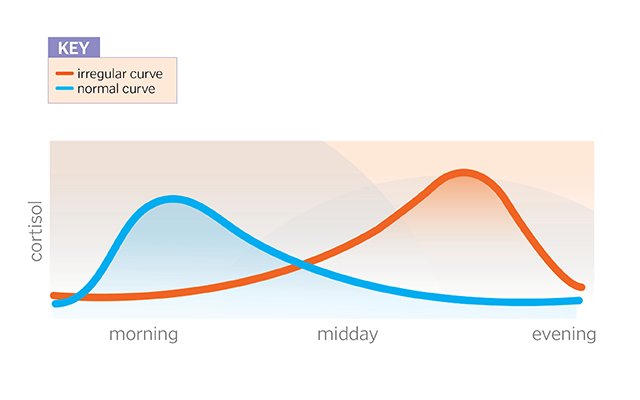
When cortisol is high low during the day but high at night, you’ll have a “tired and wired” feeling. You’ll be tired during the day, probably need coffee to keep up. But at night, when you wish you could sleep, you’ll get a jolt of energy.
In this scenario, you’ll often get a “tired and wired” feeling, where you’re tired when you should be alert, and alert when you should be normally be tired. Your sleep tanks, energy sinks further, and your brain becomes foggy.
At the same time, with your body always in 'fight or flight,’ you might develop digestion problems, irregular menstrual cycles, bad PMS/menopause symptoms, and diminished sex drive as energy is diverted away from healthy hormone production, digestion, and sexual reproduction.
For many people, mental stress & fatigue will spur coping behaviors that further stress your body: poor food choices, drinking alcohol to relax, not exercising, not prioritizing sleep, and trying to do more and more to ‘keep up’.
Now, let’s say things keep going like they’re going.
Constantly responding to stress takes a heavy toll on your body. And so your body- it its innate wisdom- takes steps to keep you safe. In this case, the step is for the pituitary gland to stop telling your adrenal glands to make so much cortisol.
And cortisol production starts to look like this:
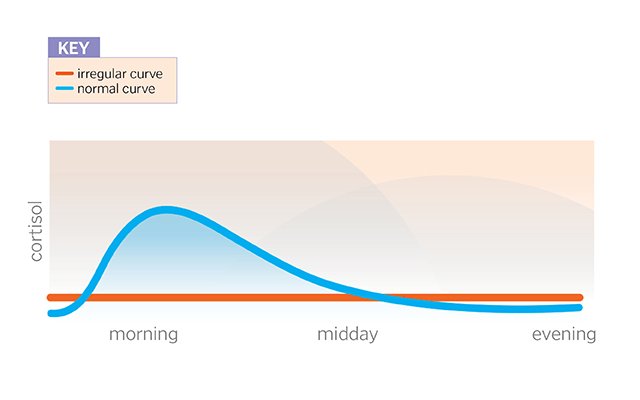
When you’re fully burntout, cortisol will be low most or all of the time, leaving you exhausted.
If you’ve got overall low cortisol, you’re probably feeling exhausted no matter how much sleep you get.
Some people like to call this “adrenal fatigue”, but it’s not an accurate term (and definitely is not a medical diagnosis). What’s really happening is NOT that your adrenal glands are weak or tired. It’s that they’re no longer getting the message to produce cortisol.
A couple other more accurate terms some people use to describe this scenario are HPA axis dysregulation or adrenal dysfunction (though these terms can usually apply whether you’ve got overall high cortisol, a cortisol roller coaster, or low-cortisol.)
Bottom line: if you’ve gotten to the point where cortisol is low, you're burnt out, and feel like you’re hitting a wall, then your body has likely been under a high degree of stress, probably for months or years. It’s slowing down. And it’s sending you the message that it’s time to take action.
How to start healing your body and mind from chronic stress and burnout
There’s a LOT of things you can do to start healing your body from stress.
When I work with women in my burnout recovery program, THRIVE, we almost always begin with foundational self-care- making sure she’s feeding herself nutritious and energizing food, getting good sleep, and moving her body. You can read more details about that in this blog post.
Within a couple weeks that usually boosts her energy enough to start digging into the more difficult work of burnout recovery, which can involve steps to regulate the nervous system and set boundaries.
If you feel like you’re at that point of burnout, and you want to learn my holistic approach to burnout recovery, then you should definitely watch my free training!
For further reading
I know there’s a ton of conflicting health information out there, so I wanted to give you a couple additional sources you can turn to for further information about the linkage between stress and your health.
The Adrenal Thyroid Revolution, by Aviva Romm, is a really comprehensive book that explains everything I’ve written about here but in much greater detail.
If you like listening to podcasts, click here for a good one from Dr. Mark Hyman, discussing HPA axis dysfunction and adrenal burnout (terms he uses)
If you’ve got questions, shoot me an email or leave a comment below!
